Editor’s Disclosure
HEREFlorence.com is published by HERECity Network, an independent local news organization. Your Indoor Golf Solutions, the subject of this article, has a business relationship with HERECity Network as a technology and services partner. This article was reported, written, and edited by a HERE editor to HERECity Network’s editorial standards. Your Indoor Golf Solutions reviewed the article for factual accuracy regarding its own business operations only; editorial judgment and final publication decisions rest with HERECity Network. See our Editorial Standards.
Ask a serious golfer what happens to a swing over a cold, wet January and most will wince before they answer. Tempo drifts. Timing goes soft. By the time the course dries out, weeks of muscle memory have to be rebuilt from scratch. That annual reset is quietly becoming optional.
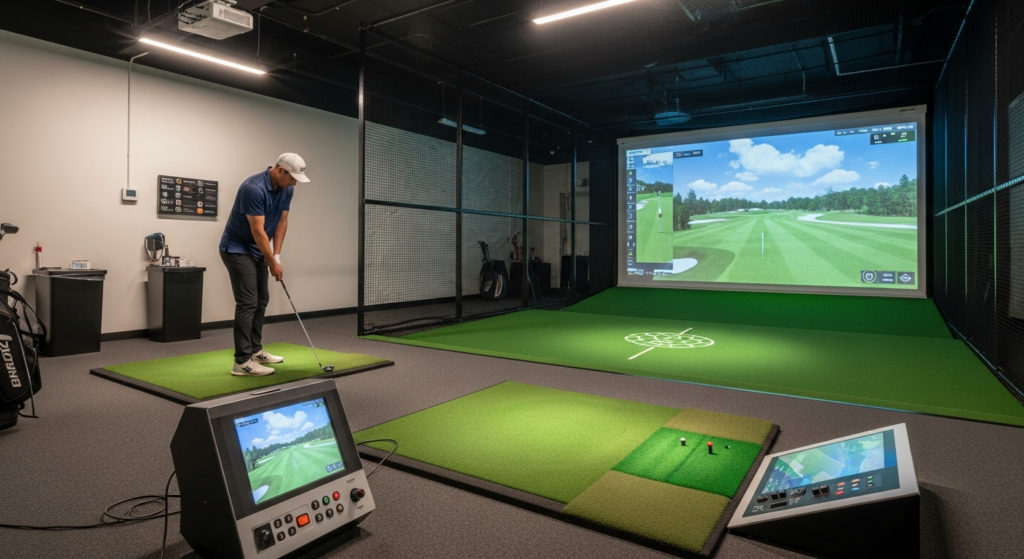
Launch-monitor technology has advanced to the point where indoor practice sessions can capture the kind of swing data that used to require a coach standing on a range with a notebook. Clubhead speed, spin rate, launch angle, carry distance — all measurable indoors, in real time, regardless of what the weather is doing outside. That capability is a meaningful part of why 28 million Americans visited a golf simulator venue in 2024, per Mordor Intelligence’s 2026 report — a figure that, for the first time, topped visits to traditional outdoor driving ranges.
For Florence-area golfers who treat the offseason as a threat to their handicap rather than a break from the game, that data layer changes what “practice” means between November and March.
Data replaces guesswork
The launch monitors driving this shift — Foresight Sports’ GCQuad and GC3 among the most widely used in both commercial venues and serious home setups — track ball and club data with a precision that turns practice into something closer to lab work. Instead of guessing why a shot leaked right, a player can see the spin axis and clubface angle that caused it, then make an adjustment and check the next shot’s numbers immediately.
That immediacy is what separates simulator practice from simply hitting balls into a net. A golfer working on a swing flaw gets confirmation or correction within seconds, not over the course of a season of trial and error outdoors.
Coaching finds a year-round home
The same technology has changed what instruction looks like. A PGA-certified coach working with simulator data can diagnose a swing issue with the same launch-monitor numbers a tour player would use, without needing a single outdoor range day. That’s a meaningful shift for instructors and serious amateurs in the Florence area who’ve historically lost coaching momentum every winter.
It’s also part of why simulator use has grown fastest among golfers who are the most invested in their own improvement. The National Golf Foundation reports that simulator use among golfers age 50 and older has risen 184% over the past four years — a cohort disproportionately made up of players focused on maintaining, not just enjoying, their game.
What separates a real training tool from a toy
Not every simulator setup is built for player development. Some commercial installs are tuned for entertainment — big screens, casual scoring, a fun night out — while others are configured specifically for the kind of granular data a coach or serious player needs. The difference usually comes down to launch monitor quality and how the software is set up, not the size of the screen.
Knowing which configuration actually supports real improvement, versus which one is just for fun, is where a PGA-credentialed consultant’s opinion is worth more than a sales brochure.
What the growth curve says about demand
None of this is a niche trend anymore. The global golf simulator market is valued at $1.97 billion in 2025, climbing toward $3.35 billion by 2031 at a 9.37% compound annual growth rate, according to Mordor Intelligence’s 2026 report. Business Research Insights separately projects the broader indoor golf simulator market at $1.86 billion in 2026, rising to $6.95 billion by 2035 — a 15.6% compound growth rate that reflects both commercial venue expansion and a wave of serious home-practice buyers.
For Florence golfers deciding whether winter simulator work is worth the investment, that scale of industry growth is itself a signal: enough serious players are choosing to train this way that the technology and coaching methods built around it are only getting more refined.
Local Sports Lens
Your Indoor Golf Solutions, PGA Pro-owned by Greg Sheffield, has spent 25 years installing indoor golf simulators for homes, businesses, restaurants, and bars. The company works with clients nationwide — including South Carolina — and provides consulting on which technology tier, space configuration, and F&B integration makes sense for a given venue. Businesses considering a simulator install can request a consultation at (309) 826-0439 or via the HERE partner page.
Winter will keep coming to Florence every year. What golfers do with those months, increasingly, is a choice rather than a forced pause.